Treasure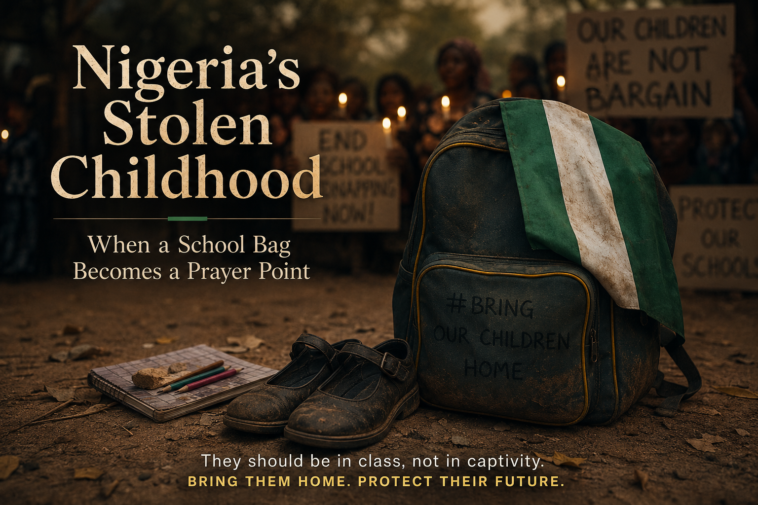
There is a kind of pain that words cannot convey well. It is the pain of a mother who prepared her child for school in the morning and did not know she was dressing that child for captivity. It is the pain of a father who hears a rumor, then a name, then silence. It is the pain of a classroom suddenly emptied, a bed left untouched, a school uniform folded in a corner, and a family waiting for news that may not come quickly enough.
Across communities, the kidnapping of schoolchildren has become one of the cruelest signs of our national insecurity. A child should never have to choose between education and survival, and a parent should never have to wonder whether sending a child to school is an act of hope or a dangerous risk. Yet for too many Nigerian families, the simple morning routine of bathing a child, packing food, checking a school bag, and saying “read well” has become surrounded by fear.
As a mother, this breaks me. As a Nigerian, it angers me. As a soldier’s wife, I also find myself asking difficult questions about protection, leadership, duty, and the value we place on human life.
A nation that cannot protect its children cannot honestly claim to be at peace.
These Are Children, Not Headlines
When news breaks that children have been kidnapped, the country often responds first with numbers. How many were taken? How many escaped? How many are still missing? How many security officers have been deployed? How many days have passed?
But behind every number is a child with a name.
A child who may be afraid of the dark.
A child who may still sleep with a favorite wrapper, teddy bear, Bible, Quran, school notebook, or small memory from home.
A child who may be hungry, thirsty, sick, confused, or silently wondering why no one has come yet.
A child who should be learning multiplication, not memorizing the sound of gunshots.
A child who should be writing essays, not becoming one.
We must stop allowing numbers to numb us. Statistics may help us understand scale, but they should never take away the sacredness of each life. Every kidnapped child is someone’s baby, and every missing student is a broken home waiting at the gate.
The School Has Become a Place of Fear
In every healthy society, the school is supposed to represent safety, discovery, discipline, friendship, and possibility. It is where children learn to read the world and imagine a future beyond their parents’ struggles. For many Nigerian families, education is not a luxury. It is the ladder out of poverty. It is the sacrifice of a mother selling in the market, a father farming through pain, an older sibling delaying dreams so the younger ones can go further.
When armed men invade schools, they do more than kidnap children.
They attack a community’s future.
They tell girls that learning makes them vulnerable.
They tell boys that classrooms are not safe.
They tell teachers that service may cost them their lives.
They tell parents that hope is dangerous.
The effect does not end when a child is released. The trauma follows the child home. It follows the mother into sleep. It follows the father into silence. It follows the community into every school morning after that. Some children may never return to school. Some parents may never again trust the road, the dormitory, the classroom, or the promise that “security is under control.”
That is how kidnapping destroys more than one child at a time. It steals confidence from entire communities.
We cannot normalize the Abduction of Children.
Nigeria has become too familiar with grief. We have heard too many stories of children taken from classrooms, dormitories, roads, farms, and villages. We have watched families cry on television. We have seen communities protest. We have heard promises. We have used hashtags. We have prayed. We have waited.
Then another abduction happens.
This cycle should disturb our conscience. It should trouble our leaders. It should keep everyone in authority awake until the children are returned and the schools are protected.
We must not become a people who adjust to evil. We must not say “this is Nigeria” as if suffering is our culture. Kidnapping is not normal. Terror is not normal. Children disappearing from school is not normal. Parents paying ransom for the lives of their own children is not normal. Communities closing schools because learning has become unsafe is not normal.
A country does not lose its soul in one day. It loses it slowly, each time outrage becomes routine.
Protection Must Be More Than Promises
It is not enough for government officials to visit grieving families after children are taken. It is not enough to issue statements. It is not enough to condemn attacks. Condemnation without prevention becomes a ritual of failure.
Nigeria needs a serious, transparent, and accountable child protection response.
Schools in vulnerable areas need more than gates and slogans. They need risk assessment, early warning systems, trained security coordination, safe transportation plans, emergency communication channels, and clear rescue protocols. Teachers need to know what to do before, during, and after a threat. Parents need timely information. Communities need to be part of protection planning. Security agencies need intelligence that reaches the local level before tragedy happens.
There must also be accountability. When warnings are ignored, someone should answer. When funds are allocated for safe schools, but children remain exposed, someone should explain why. When families are left in the dark, someone should be held responsible for that silence.
Our children cannot be protected by speeches. They need systems that work.
Families Need Care After Rescue
When kidnapped children return, the public often celebrates and moves on. But return is not the end of the story. For many children, it is the beginning of another difficult journey.
A rescued child may carry fear, shame, nightmares, injuries, grief, or confusion. Some may have witnessed violence. Some may have lost friends or teachers. Some may struggle to sit in a classroom again. Some may need medical care, counseling, spiritual support, and patient reintegration into school and community life.
Their parents also need care. Waiting for a kidnapped child is its own form of torment. Mothers and fathers may blame themselves. Siblings may feel forgotten. Families may sell property, borrow money, or live with debt in response to ransom demands. Communities may become divided by suspicion and fear.
Public health must be part of the response. Trauma care should not be treated as an afterthought. Mental health support, family counseling, community healing, and school reintegration should be built into every rescue and recovery plan.
A child who survives captivity should not be abandoned to survive the memories alone.
The Diaspora Must Not Look Away
Those of us outside Nigeria cannot pretend this is far from us. Distance does not cancel responsibility. Many of us left home, but home did not leave us. Our villages, schools, churches, mosques, markets, and family compounds are still tied to our hearts.
We must use our voices with wisdom and courage.
We can support trusted local organizations working with displaced families and survivors. We can advocate for child protection funding that reaches communities. We can keep these stories alive when the news cycle moves on. We can write to representatives, support trauma care efforts, amplify credible reports, and refuse to let kidnapped children become yesterday’s tragedy.
We must also be careful not to turn suffering into a political performance. The pain of kidnapped children should not be used for ethnic hatred, religious mockery, or partisan noise. The lives of children are too sacred for that. Nigeria’s children include Christians, Muslims, and children of many traditions. They come from different tribes and regions. Their tears speak the same language.
A kidnapped child is not first a political argument. A kidnapped child is a human being made in the image of God.
A Mother’s Prayer and a Nation’s Duty
I think of the mothers waiting. I think of the fathers trying to look strong. I think of the children who escaped and the children who did not. I think of the teachers who stood between their students and danger. I think of the communities where school bells no longer sound the same.
And I pray, Lord, bring the children home.
But prayer must not become an excuse for inaction. Faith should move us toward justice, not away from responsibility. Proverbs 31:8 tells us to speak up for those who cannot speak for themselves. These children need our voices. Their parents need our solidarity. Their teachers need protection. Their communities need safety. Their country needs courage.
Nigeria must decide that the life of a child is worth more than ransom money, political delay, public relations, or official excuses.
Let this be the line we refuse to cross again.
No child should be stolen from a classroom.
No mother should have to bargain for the life of her child.
No father should have to search forests with a broken heart.
No teacher should be killed for the sacred work of educating children.
No nation should sleep peacefully while its children are missing.
Bring them home.
Protect the ones still in school.
Care for the ones who return.
And let Nigeria become a country where a school bag is once again a symbol of hope, not a prayer point for survival.
Discover more from The Soldiers Wife
Subscribe to get the latest posts sent to your email.